Growing a design practice inside a global media and data business
When I joined Dow Jones as Design Director, there was a single designer supporting multiple product teams across a global media and financial data business. Products were being scoped and built without user research, and design was brought in late to produce UI rather than shape decisions.
The business understood it needed design, but hadn't built the structures for design to have real impact. My job was to change that: build the team, establish process, and prove the value of research-led design in a business that moved fast.
Dow Jones runs some of the world's most trusted data and news products — the Wall Street Journal, Barron's, Factiva, and risk and compliance tools used by banks and financial institutions. Poor experiences here cost subscriptions and damage credibility with professional audiences who know exactly what they want.
To improve product quality at scale, we needed the right team in place, working the right way, embedded where decisions were actually made.
I made the case for investment in design by linking team capacity directly to product outcomes. Starting from a single designer, I hired deliberately, bringing in skills the team genuinely lacked rather than just adding more of the same.
The hires that made the biggest difference: a dedicated User Researcher, who gave us the ability to run discovery work in parallel with delivery; and a UI Systems Designer, who helped us build consistency across a fragmented product suite.
I introduced a double diamond design process across the organisation. Not as a rigid framework, but as a shared language for how we approach problems. Discover, Define, Ideate, Design, Deliver. Each phase has a distinct purpose, and understanding that helped product and engineering teams work better with us.
Embedding research into the delivery cycle was the real shift. Moving research upstream meant designers were helping shape what got built, not just reviewing designs after decisions had already been made.
Changing a design in Figma takes hours. Changing it in code takes days. Changing it in production takes weeks and damages trust. Investing in research and design upfront is the least expensive way to build the right thing.
When engineers start with well-considered, tested designs, there are fewer surprises mid-sprint. Requirements are clearer, edge cases are already handled, and teams can move faster through build and QA.
User research surfaces problems before they become product problems. Finding usability issues, unmet needs, and workflow friction in research is far cheaper than finding them in support tickets and churn data.
The core design challenge at Dow Jones was coherence. Across news, data, compliance, and analytics, each product had evolved on its own roadmap and showed it. Inconsistent UI, fragmented patterns, experiences that felt like separate tools with nothing in common.
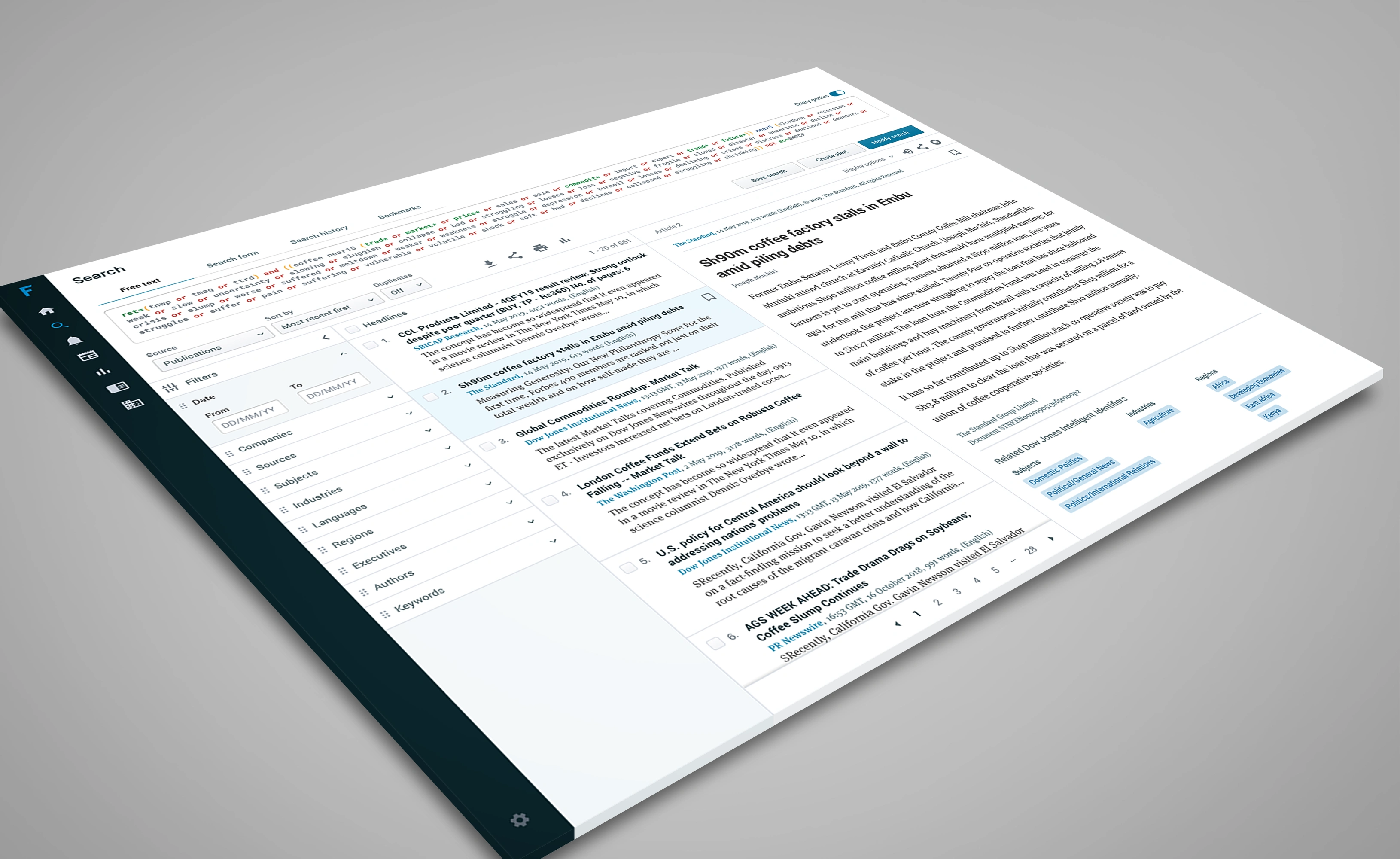
We redesigned across the product suite using a shared design system as the foundation. This was a structural change to how products were built, not just a visual refresh. Common components, consistent interaction patterns, and a shared visual language let us raise quality across the whole portfolio at once.
Dow Jones product interface
The design system was what made a coherent suite possible. We built a component library and pattern documentation that product teams could actually use. Not aspirational documentation that sat untouched, but something that evolved with the products and got adopted.
With a systems designer dedicated to this work, we reduced the overhead of new features, eliminated duplicate design decisions, and gave engineering a single source of truth. Teams shipped faster and the products started to feel like they belonged together.
Looking for design leadership roles at manager or director level. B2B, enterprise, or data products. Based in the UK, open to remote.